Agentic RAG Knowledge Assistant
A retrieval-augmented generation system that checks its evidence before answering, retries with a reformulated query, and refuses when the evidence is not there.
AI / Data Engineer, Aug 2026 – Present. Open source.
Python, OpenAI API, Rank-BM25, NumPy, Pydantic, Streamlit
The problem
A standard RAG pipeline retrieves the top few chunks and answers straight away. When the question is out of scope or rests on a false premise, nothing stops the model from answering from memory.
The project tests whether a closed loop of plan, retrieve, audit, retry and then generate or refuse reduces unsupported answers, and measures what that costs in answer coverage, latency and API spend.
Approach
A Python pipeline over a corpus of 10 research papers. Dense vector search and BM25 are fused with Reciprocal Rank Fusion (k = 60). An evidence auditor checks claims against the retrieved chunks, and the system retries up to twice before it answers or refuses. Embeddings are cached by SHA-256 content hash.
Architecture
Plan, retrieve, audit, retry, then generate or refuse. Each stage is a separate module in the repository.
6 stages. Select one to see what it does and where it sits in the flow.
Stage 1 of 6, interface
User question
The question arrives through the Streamlit app or a script.
In the flow: The planner breaks the question into sub-queries.
Read the whole flow in order
- The planner breaks the question into sub-queries.
- The hybrid retriever searches the BM25 index and the dense vector store and fuses the rankings, keeping the top 5 chunks.
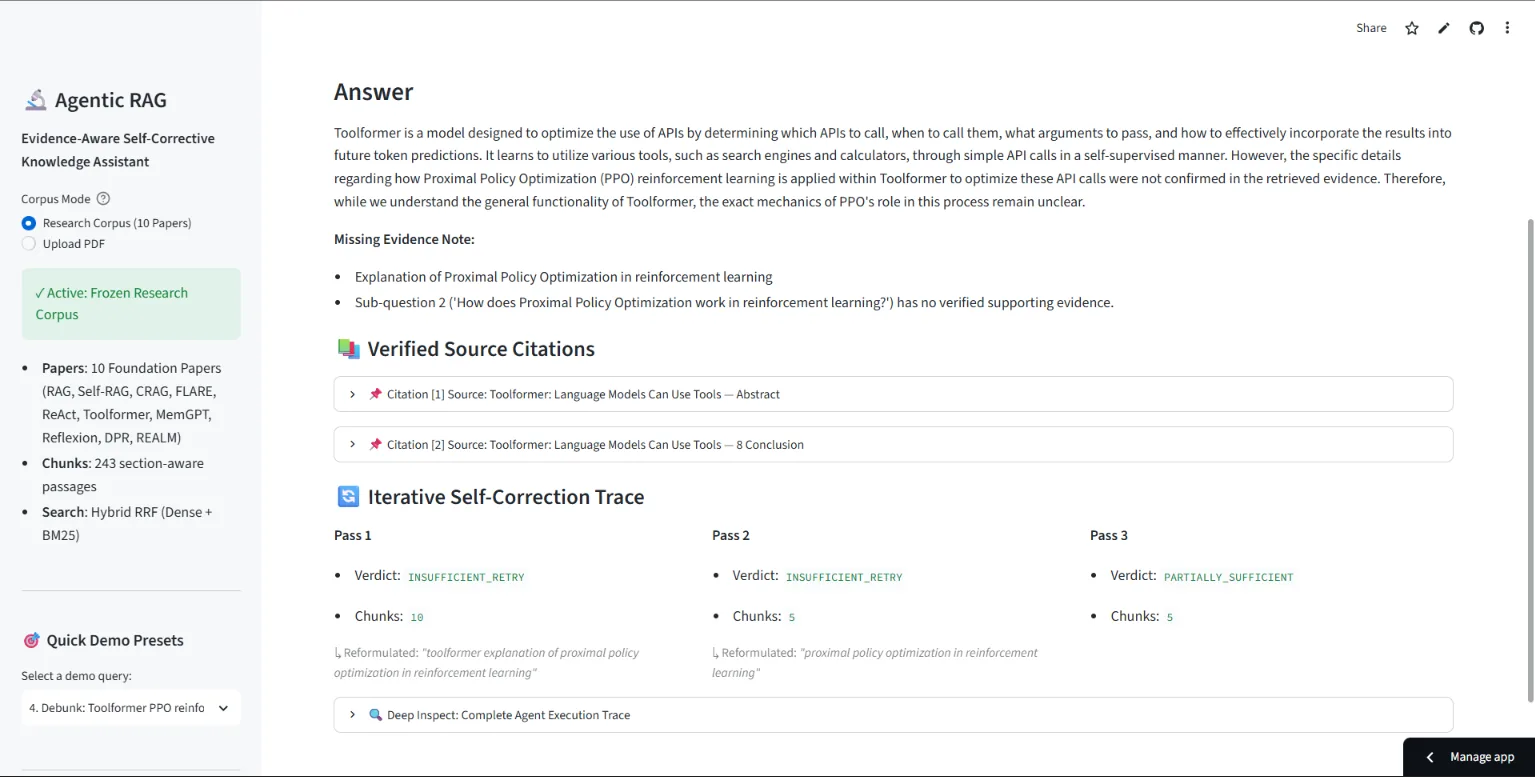
- The evidence auditor checks the claims against those chunks and returns a verdict such as SUFFICIENT, PARTIALLY_SUFFICIENT or INSUFFICIENT_RETRY.
- If the evidence is insufficient, the query is reformulated and retrieval runs again, up to 2 retries.
- With enough evidence, gpt-4o-mini writes the answer with source citations. Without it, the system returns a partial answer with a missing-evidence note, or refuses.
Design choices
Fusing two retrievers by rank
What it does: Dense and BM25 results are combined with Reciprocal Rank Fusion (k = 60), which uses each result's rank rather than its raw score, so the two scoring scales do not need normalising.
What it costs: Two indices to maintain and two searches per query.
Auditing evidence before generating
What it does: An LLM-based audit step, with deterministic quote verification, decides whether the retrieved evidence is enough before an answer is written.
What it costs: The auditor accounts for about 88.2% of average latency (15.60 s of 17.69 s) and about 81.4% of benchmark API spend ($0.237 of $0.291).
In the product

Code excerpt
    def _retrieve_hybrid(
        self,
        query: str,
        top_k: int,
        filters: Optional[Dict[str, Any]],
        dense_weight: float,
        sparse_weight: float
    ) -> List[SearchResult]:
        """
        Executes Reciprocal Rank Fusion over candidate pools from Dense and BM25 retrievers.
        """
        # Fetch wider candidate pools (e.g. 2x top_k or at least 20 candidates) for robust fusion
        candidate_k = max(top_k * 3, 20)

        dense_hits = self.vector_store.search(query, top_k=candidate_k, filters=filters)
        sparse_hits = self.bm25_engine.search(query, top_k=candidate_k, filters=filters)

        # Lookup maps: chunk_id -> (score, rank)
        dense_map: Dict[str, Tuple[float, int]] = {c.chunk_id: (score, rank) for c, score, rank in dense_hits}
        sparse_map: Dict[str, Tuple[float, int]] = {c.chunk_id: (score, rank) for c, score, rank in sparse_hits}

        # Union of all candidate chunk IDs
        all_chunk_ids = set(dense_map.keys()) | set(sparse_map.keys())

        # Compute RRF score for every candidate
        scored_candidates: List[Tuple[str, float]] = []
        for cid in all_chunk_ids:
            rrf_score = 0.0
            if cid in dense_map:
                _, d_rank = dense_map[cid]
                rrf_score += dense_weight * (1.0 / (self.rrf_k + d_rank))
            if cid in sparse_map:
                _, s_rank = sparse_map[cid]
                rrf_score += sparse_weight * (1.0 / (self.rrf_k + s_rank))
            scored_candidates.append((cid, rrf_score))

        scored_candidates.sort(key=lambda x: x[1], reverse=True)
        top_candidates = scored_candidates[:top_k]
Excerpt, copied from the repository, of the fusion step in the hybrid retriever. The dense and BM25 contributions can be weighted separately.
Results and facts
Eight configurations were run on the 32-question held-out test set of a 40-question dataset (8 development, 32 held-out). The test set has 24 answerable, 4 unanswerable and 4 false-premise questions, and answer accuracy is calculated over the 24 answerable ones. The figures here are the frozen results from before later fixes to the auditor, which the repository labels "frozen pre-fix". The full system had 55.2% citation precision and 52.1% evidence recall. The figures above come from small samples: four unanswerable and 24 answerable questions.
- Hallucinations on unanswerable questions
- 0 / 4Four unanswerable questions in the 32-question held-out set. The hybrid RAG baseline hallucinated on 4 / 4.
- Correct refusals
- 4 / 4All four unanswerable questions were refused.
- Answer accuracy
- 45.8%A human-reviewed score of 11.0 / 24 on the answerable questions. The hybrid baseline scored higher, 60.4% (14.5 / 24).
- Wrongly refused
- 12.5%3 of the 24 answerable questions were refused when they should have been answered.
- Average latency
- 17.7 sAgainst 1.86 s for the hybrid baseline, roughly 8.5 times slower.
- Automated tests
- 9090 test functions; 87 run offline by default with no API calls, and 3 live integration tests are opt-in.
Limitations
- The audit loop is slow: about 17.7 s per question against 1.86 s for the single-pass baseline.
- The conservative evidence gate costs coverage. It wrongly refused 12.5% of answerable questions and scored lower accuracy than the baseline.
- The test sample is small, with four unanswerable and 24 answerable questions, so the 0 / 4 result is a single small test, not a rate.
- On one false-premise question (Q38) the system tried to answer instead of challenging the premise. A contradiction check was added after the evaluation run, so the published numbers do not include it.