AI Data Analyst Agent
A data analysis agent that routes each question to one of four fixed tools, restricts SQL to single SELECT/WITH statements with regex keyword guardrails (35 blocked keywords) on an in-memory DuckDB connection, and checks the numbers in its answer against the tool output.
AI / Data Engineer, Aug 2026 – Present. Open source.
Python, DuckDB, Plotly, Streamlit, Pydantic, Pandas
The problem
An agent that writes and runs arbitrary Python can crash, can behave differently from run to run, and is a security risk to execute.
To see whether a language model can be limited to choosing a tool and filling in its parameters, with the computation done by fixed code that can be inspected.
Approach
An LLM router (gpt-4o-mini) picks one of four tools (query_data, plot_chart, summary_stats, clarify) and extracts its parameters. SQL runs in DuckDB behind a 35-keyword regex filter, results are capped at 500 rows, and a guard compares the numbers in the written answer with the tool output.
Architecture
A dataset profiler, an LLM router, four fixed tools over an in-memory DuckDB table, and a numeric check on the answer.
6 stages. Select one to see what it does and where it sits in the flow.
Stage 1 of 6, interface
Streamlit app and CLI
A web app and a terminal interface, both with CSV upload.
In the flow: A dataset is loaded: the bundled Superstore sales file (7,500 rows) or an uploaded CSV.
Read the whole flow in order
- A dataset is loaded: the bundled Superstore sales file (7,500 rows) or an uploaded CSV.
- The profiler computes the schema, missing values and reference years.
- The user asks a question in plain English.
- The router picks one tool and returns its parameters.
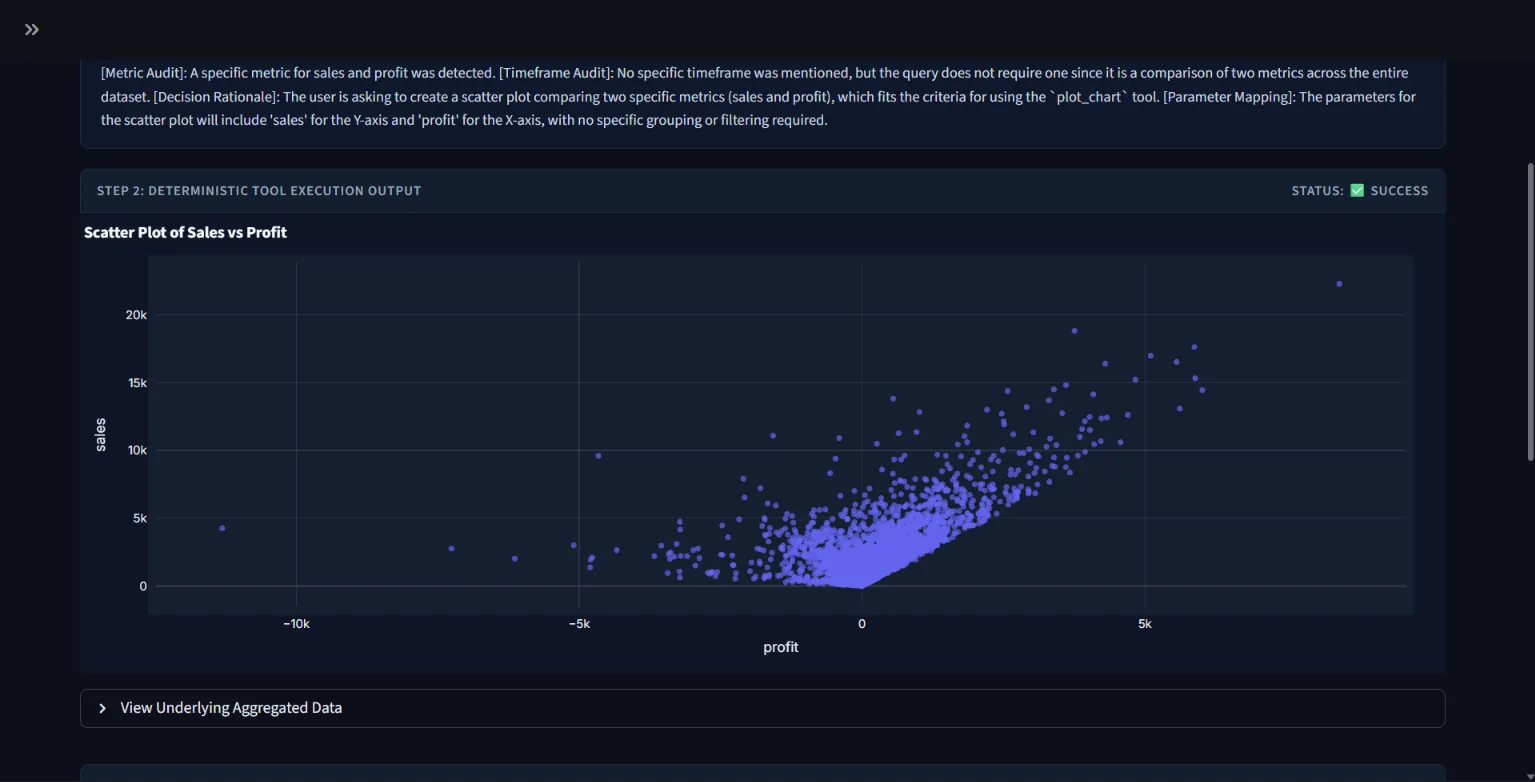
- The tool runs: a DuckDB query, a Plotly chart, or summary statistics. Ambiguous questions go to the clarify tool.
- The answer is written, and the numeric guard checks the numbers in it against the tool output.
Design choices
Four fixed tools instead of generated code
What it does: The model chooses a tool and its parameters. The analysis itself runs in pre-written tools backed by DuckDB and Plotly.
What it costs: No custom analysis outside those tools. Each question runs as a single step, with no multi-step planning or memory.
A regex filter for SQL
What it does: Queries must start with SELECT or WITH, contain a single statement, and avoid 35 blocked keywords (mutation, file-system and administrative commands).
What it costs: It is a keyword blacklist, not a parser and not an allowlist, so it is weaker than parser-based validation. It is not engine-enforced read-only access, and it does not guarantee that every external file read is blocked.
Reference years from the data
What it does: The repository records a bug where "this year" resolved to the model's training cutoff. The profiler now computes reference years from the dataset and puts them in the prompt.
What it costs: It needs a profiling pass whenever a dataset is loaded.
In the product
Code excerpt
    def validate_sql(self, sql_query: str) -> None:
        """
        Validates that the SQL query is strictly read-only and safe.
        Raises ValueError on any violation.
        """
        clean_sql = sql_query.strip()

        # Remove comments (-- or /* */) before validation
        clean_sql = re.sub(r"--.*?(\n|$)", " ", clean_sql)
        clean_sql = re.sub(r"/\*.*?\*/", " ", clean_sql, flags=re.DOTALL).strip()

        # Must start with SELECT or WITH (for CTEs)
        upper_sql = clean_sql.upper()
        if not (upper_sql.startswith("SELECT") or upper_sql.startswith("WITH")):
            raise ValueError("Security violation: Only read-only SELECT and WITH (CTE) queries are permitted.")

        # Disallow statement chaining with semicolons
        semicolon_count = clean_sql.count(";")
        if semicolon_count > 1 or (semicolon_count == 1 and not clean_sql.endswith(";")):
            raise ValueError("Security violation: Multiple chained SQL statements are not allowed.")

        # Check for disallowed mutating / DDL / administrative keywords
        for forbidden in config.disallowed_sql_keywords:
            pattern = rf"\b{forbidden}\b"
            if re.search(pattern, upper_sql):
                raise ValueError(f"Security violation: SQL keyword '{forbidden}' is prohibited in read-only mode.")
Copied from the repository. This is the whole SQL guard: a regex keyword blacklist plus checks for SELECT or WITH and a single statement. The docstring and error messages say "read-only", but the guard is a keyword filter on an in-memory DuckDB connection, not engine-enforced read-only access.
Results and facts
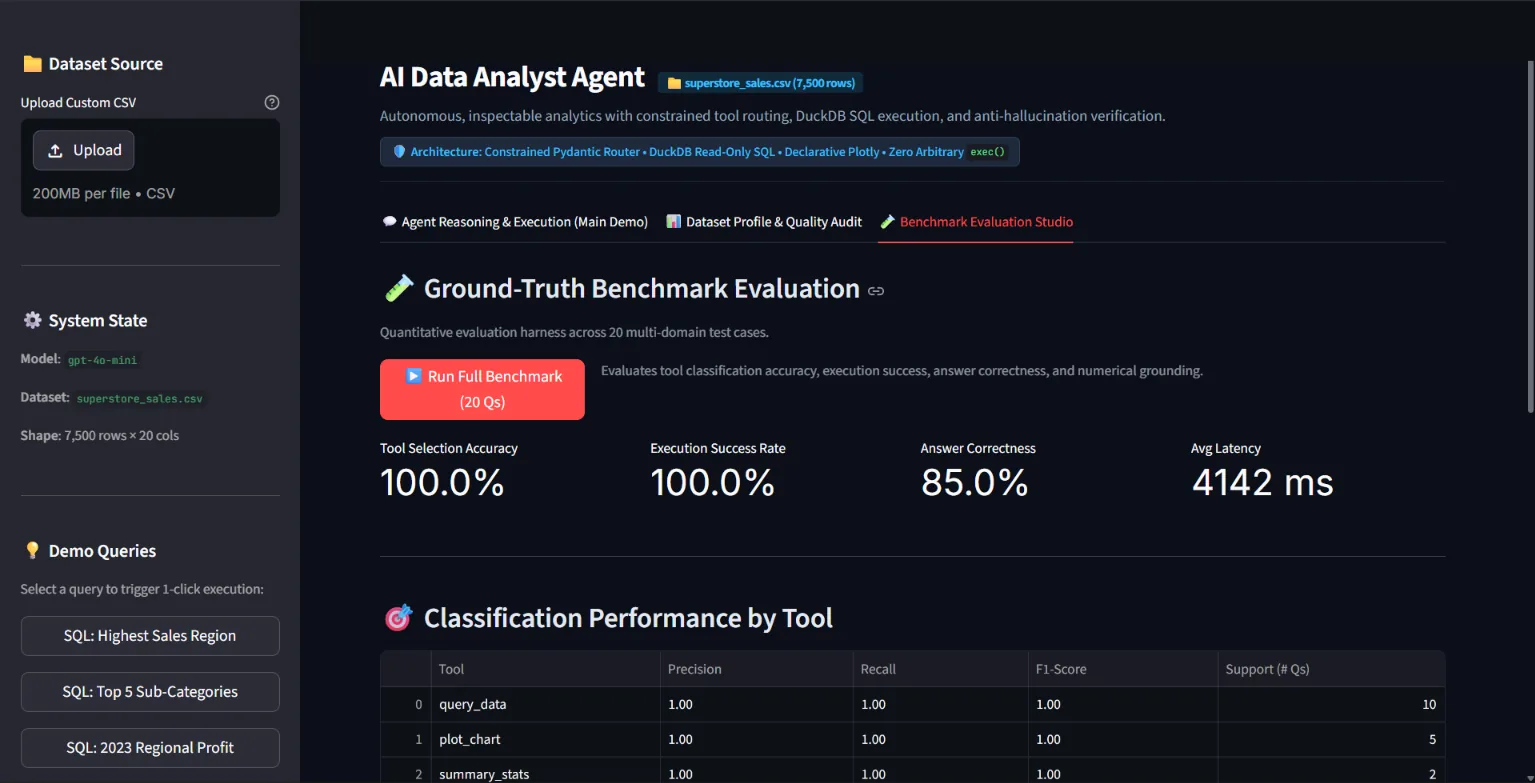
A 20-question ground-truth benchmark on the bundled Superstore sales data, covering lookups, aggregations, regional comparisons, charts, descriptive statistics and ambiguous prompts. It is a small, single-dataset test. The repository also lists "industry baseline" figures next to these results; they are not measured comparisons, so they are not repeated here.
- Tool selection
- 100.0%20 / 20 questions routed to the expected tool.
- Execution success
- 100.0%20 / 20 tool runs completed without an error.
- Answer correctness
- 85.0%17 / 20 answers matched the expected value.
- Numerical faithfulness
- 80.0%16 / 20 answers had every number match the tool output.
- Average latency
- 4,142 msAverage end-to-end time per question on the 20-question benchmark.
Limitations
- SQL safety rests on a keyword blacklist, not a parser or an allowlist. It is not engine-enforced read-only access and does not guarantee that external file reads are blocked.
- Routing is done by an LLM, so it can vary between runs.
- Each session registers one dataset as a single in-memory table.
- Questions run as one step. Multi-step planning and conversation memory are not implemented.
- The faithfulness check looks at numbers only, not wording or qualitative claims.